

A Structured Approach to Strategic Marketing
Successful marketing rarely happens by accident.
Many organisations work hard on marketing activity, yet still struggle to generate consistent growth. Campaigns are launched, budgets are spent, and teams are busy — but the results often fall short of expectations.
The underlying issue is rarely effort. It is usually a lack of strategic structure.
At Connect2Marketing, we help organisations move beyond reactive marketing activity through a proven strategic framework:
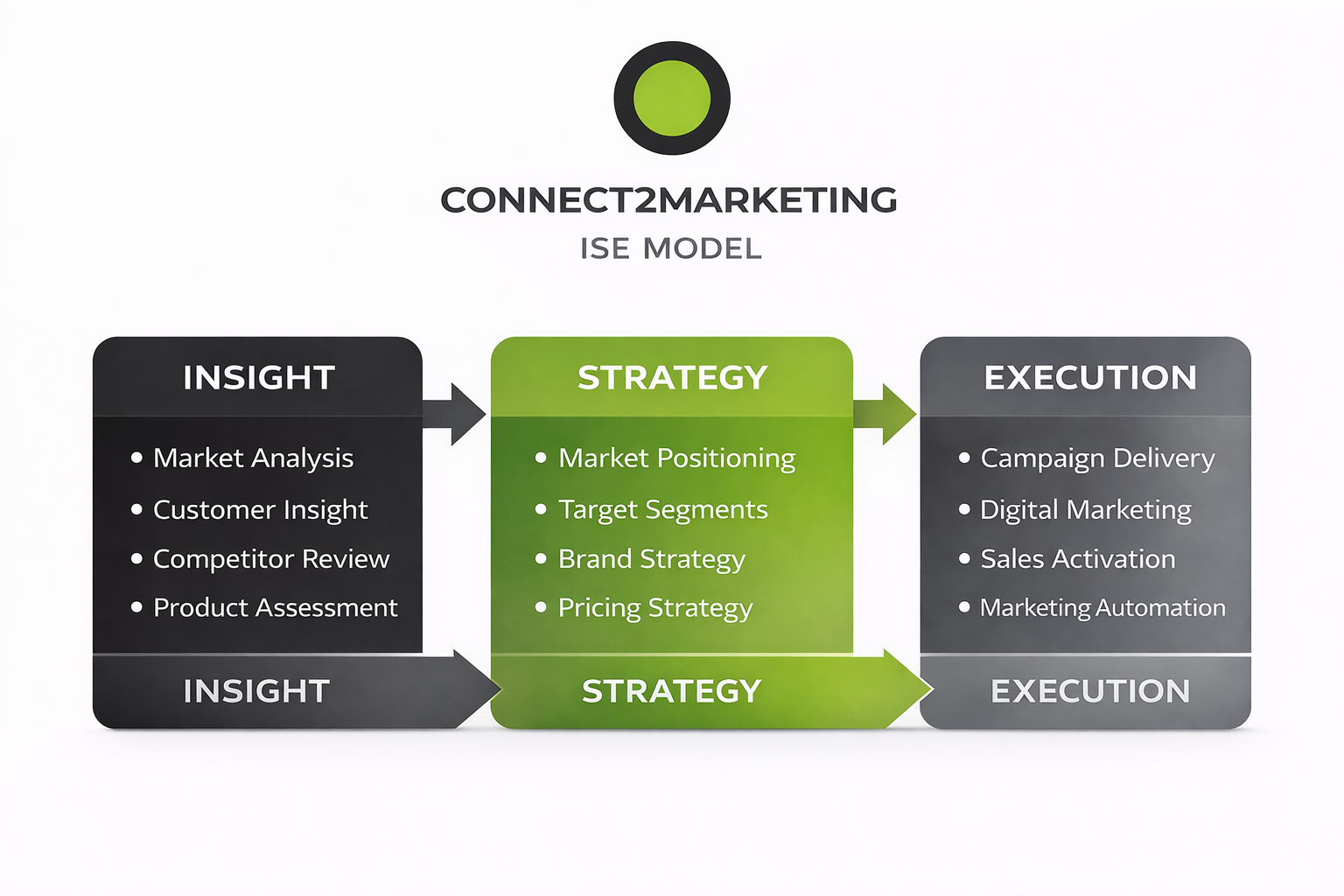
I-S-E: Insight → Strategy → Execution
This structured process ensures that marketing decisions are grounded in evidence, aligned with business priorities, and implemented with clarity and discipline.
The result is marketing that is focused, measurable and capable of driving sustainable growth.
If you are seeking to improve the effectiveness of your marketing, the I-S-E process provides a clear and practical starting point.
Arrange a Strategic Marketing Conversation →
The Problem With Tactical Marketing
Many businesses fall into a common pattern.
Marketing becomes a series of activities rather than a strategic system.
Typical symptoms include:
- campaigns that feel disconnected from business goals
- inconsistent messaging and positioning
- reactive responses to competitor activity
- uncertainty about which channels truly deliver results
- difficulty measuring the return on marketing investment
This often leads to busy marketing teams but limited strategic impact.
Strategic marketing takes a different approach. Instead of focusing first on tactics, it begins with understanding the market, defining a clear strategic direction, and then executing with discipline.
This is precisely what the I-S-E Marketing Strategy Process is designed to achieve.

Introducing the I-S-E Marketing Strategy Process
The Connect2Marketing framework is built around three interconnected stages:
Insight – Understanding the market, customers, competitors and current marketing performance.
Strategy – Defining the strategic direction that will position the business for growth.
Execution – Implementing focused marketing activity that delivers measurable results.
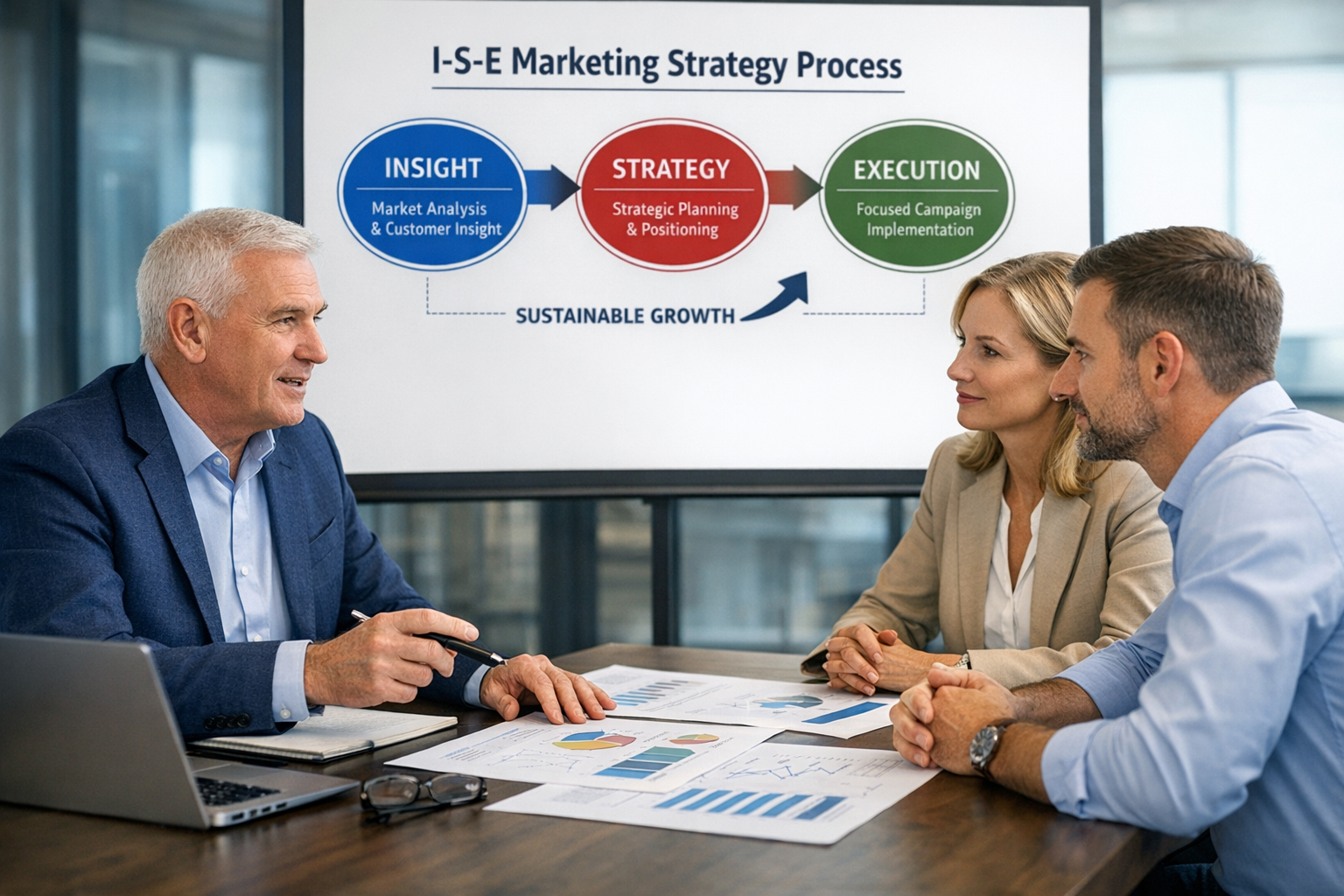
Each stage builds logically on the previous one.
Without insight, strategy becomes guesswork.
Without strategy, execution becomes fragmented.
Together, they form a coherent system for strategic marketing performance.
Stage 1 — Insight
Building the Strategic Foundation
Effective marketing begins with understanding.
The Insight phase provides the evidence and perspective required to make confident strategic decisions.
This stage typically explores areas such as:
- Market landscape and emerging trends
- Customer needs, behaviours and decision drivers
- Competitive positioning and differentiation
- Current marketing performance and effectiveness
- Brand perception and value proposition clarity
- Opportunities for growth and improvement
This process helps organisations step back from day-to-day activity and see the bigger strategic picture.
When insight is strong, marketing decisions become far more focused and confident.
Importantly, this stage also helps organisations avoid wasted marketing investment by identifying where effort should be concentrated.
Stage 2 — Strategy
Turning Insight Into Strategic Direction
Once insight has been developed, the next step is to define the strategic approach that will guide marketing activity.
The Strategy phase establishes the roadmap for growth.
This typically includes:
- Clear definition of priority target markets
- Strategic positioning and differentiation
- A compelling value proposition
- Messaging that resonates with customers
- Channel strategy and communication priorities
- Marketing objectives aligned with business goals
The aim is to create a clear and coherent strategic direction that aligns marketing activity with wider business ambitions.
When strategy is well defined, marketing becomes significantly more focused, efficient and impactful.

Stage 3 — Execution
Turning Strategy Into Results
Strategy only creates value when it is effectively implemented.
The Execution phase translates strategic intent into practical marketing activity.
This may include:
- Campaign planning and implementation
- Content and communications development
- Marketing leadership and team coordination
- Sales and marketing alignment
- Channel activation and campaign management
- Performance monitoring and optimisation
Execution is where strategy meets the marketplace.
However, the key difference in the I-S-E process is that execution always remains connected to strategy.
This ensures that marketing activity remains purposeful rather than simply reactive.
Measurement and Continuous Improvement
Strategic marketing is never static.
The final element of the I-S-E process is ongoing measurement and refinement.
This involves:
- tracking key marketing performance indicators
- analysing campaign effectiveness
- assessing return on marketing investment
- identifying opportunities for improvement
- refining strategy where necessary
By embedding measurement into the process, marketing becomes a continuous cycle of learning and improvement.
This helps organisations steadily strengthen marketing performance over time.
Why the I-S-E Process Works
The power of the I-S-E framework lies in its simplicity and discipline.
By structuring marketing around Insight, Strategy and Execution, organisations benefit from:
- greater clarity about where to focus marketing investment
- stronger strategic alignment between marketing and business goals
- more coherent and consistent messaging
- improved efficiency and effectiveness of marketing activity
- stronger customer engagement and brand positioning
- measurable improvements in marketing performance
Most importantly, it ensures that marketing becomes a strategic driver of growth rather than a collection of disconnected activities.
Who This Approach Is Designed For
The I-S-E Marketing Strategy Process is particularly valuable for:
- ambitious SMEs seeking sustainable growth
- organisations that feel their marketing lacks strategic direction
- businesses investing in marketing but unsure of the results
- leadership teams seeking stronger marketing leadership
- companies scaling into new markets or growth phases
For many organisations, applying a clear strategic framework can be the step that transforms marketing effectiveness.
Strategic Marketing Support from Connect2Marketing
Connect2Marketing works with business leaders to develop and implement effective marketing strategies that support sustainable growth.
Led by experienced marketing strategist Keith Farrell, the consultancy provides strategic guidance, mentoring and leadership support for organisations seeking to strengthen their marketing capability.
With extensive experience across multiple industries, Connect2Marketing helps organisations:
- develop clear marketing strategies
- improve marketing effectiveness
- align marketing with business objectives
- build stronger customer engagement
- deliver measurable commercial results.
Arrange a Strategic Marketing Conversation
If you would like to explore how the I-S-E Marketing Strategy Process could strengthen your organisation’s marketing effectiveness, the first step is a strategic conversation.
During this discussion we can:
- review your current marketing approach
- identify opportunities for improvement
- explore how a structured strategic framework could support your growth ambitions
Arrange a Strategic Marketing Conversation